
4 KiB
gis
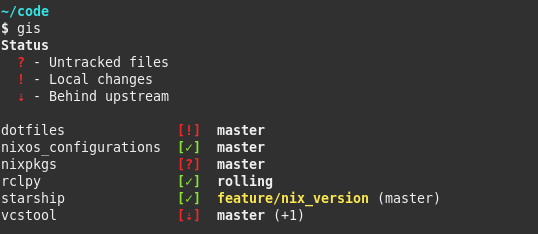
gis is a Bash script which shows a status summary of multiple Git repositories.
It was inspired by wstool, vcstool and the default Starship prompt.
Usage
  Usage: gis [OPTIONS] [COMMAND]

  Show a status summary of all Git repositories which are found recursively in
  current work directory. The colon colon-separated environment variable
  $GIS_PATH or the '-p' argument can be used to modify the search path.

  All 'fetch' and 'pull' operations are executed in parallel. The number of
  background jobs can be limited with the environment variable $GIS_JOBS or the
  '-j' argument.

  COMMANDS
    fetch  Execute 'git fetch --prune --all' for all found repositories
    pull   Execute 'git pull --recurse-submodules' for all found repositories
             which are behind upstream, includes 'gis fetch'

  OPTIONS
    -j, --jobs  N     Limit 'fetch' and 'pull' commands to N parallel jobs
    -p, --path  PATH  Use PATH for searching Git repositories
    -h, --help        Show this help message and exit
Dependencies
- At least Bash
v4 - BSD
column - Git
Installation
Manual
Place the gis script in your $PATH.
To use the autocompletion feature source the gis_completion.bash script.
ZSH
On ZSH additionally the compinit and bashcompinit modules must be loaded before sourcing the completion script:
  autoload -U +X compinit && compinit
  autoload -U +X bashcompinit && bashcompinit
Scripts
Installation scripts for Bash (install.bash) and ZSH (install.zsh) are provided which will link the two files from the current repository to ~/.local/{bin/gis,share/bash-completion/completions/gis} and add the corresponding entries to ~/.bashrc or ~/.zshrc.
Further updates of gis require just git pull in the gis repository.
Nix Flake
This repository is also a Nix Flake.
gis is provided as package under github:Deleh/gis#gis.
Configuration
The default behavior can be adjusted with the following environment variables:
| Variable | Description | Example Value |
|---|---|---|
GIS_PATH |
Colon seperated list of paths. If set, they will be used as default search paths instead of the current work directory. Can be overwritten with the --path argument. |
$HOME/git:$HOME/code |
GIS_JOBS |
Limit for the number of parallel fetch and pull jobs. |
10 |
Syntax
Status Keys
  $ - Dirty stash
  ? - Untracked files
  ! - Local changes
  + - Staged changes
  - - File removed
  » - File renamed
  = - Both modified
  ⇕ - Diverged from upstream
  ⇡ - Ahead upstream
  ⇣ - Behind upstream
  ✗ - Upstream gone
Branches
Branches which don't have the same name as the origin/HEAD reference are highlighted in yellow.
You can manually check on which branch you working tree is on by executing the following command:
git symbolic-ref refs/remotes/origin/HEAD
Note, that the reference gets only set when the repository is initially cloned and doesn't update with git fetch.
It can be updated like this:
git remote set-head origin -a
Or set it manually to any branch with:
git remote set-head origin <branch_name>
The number of additional local branches which are neither checked out, nor the origin/HEAD branch, is appended at the end of the branch output, e.g. (+8).